Lowe's BDC #3368: EDI Compliance for Suppliers
 Cogential IT Editorial Team
Your first 'yes' from Lowe's isn't the win — it's the starting gun
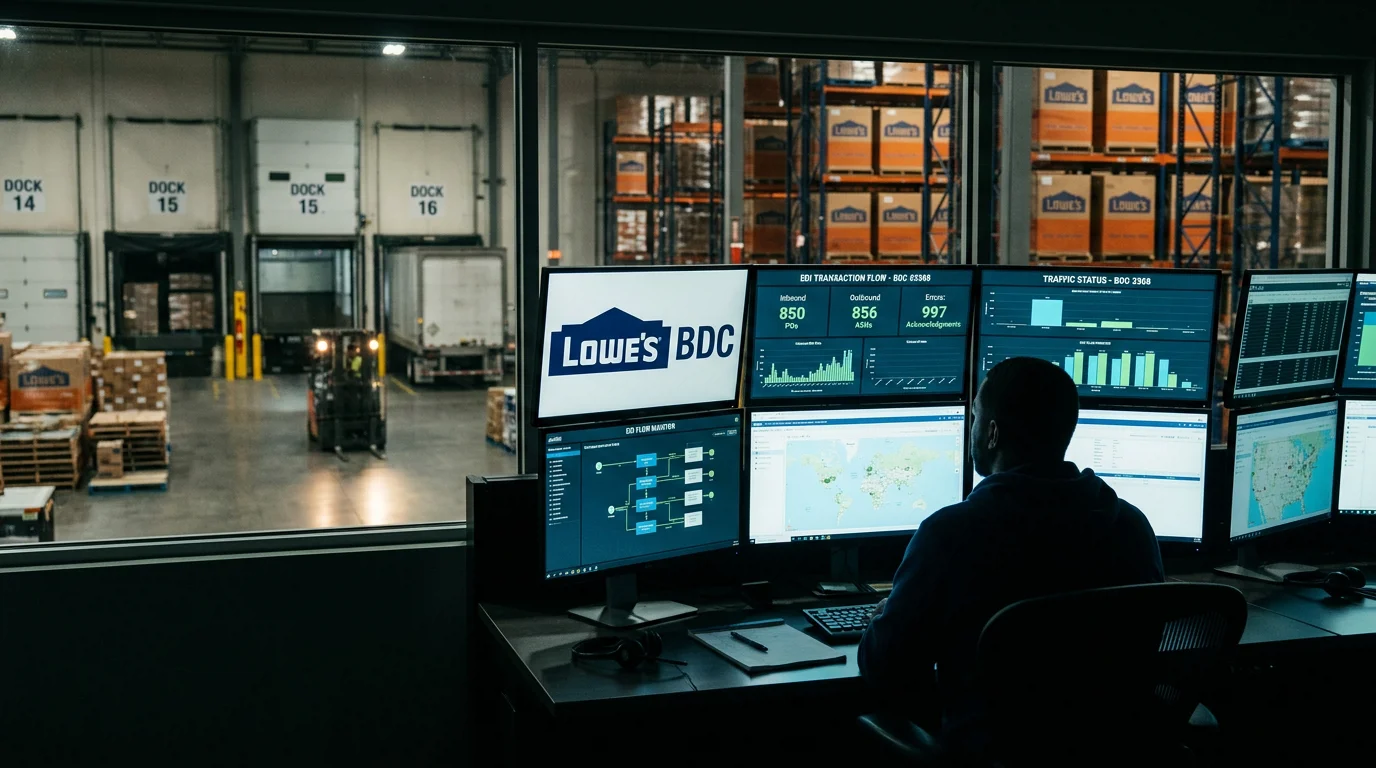
Landing a routing to a Lowe's bulk distribution center feels like crossing the finish line. Your team has chased the buyer, passed the product tests, and finally sees a purchase order come in. But the real race starts the moment that 850 PO hits your inbox. That is when Lowe's BDC #3368 EDI compliance either becomes a quiet engine behind your shipments or the reason your margins disappear into chargebacks.
Most suppliers do not fail because of bad product. They fail because the electronic paperwork does not match what Lowe's expects. One wrong ship date on an ASN, one invoice total that does not tie back to the PO, one missing 997 acknowledgment, and the deductions start. The frustrating part? The fixes are usually straightforward once you know where to look.
The painful scenario nobody warns you about
Imagine you ship a full truckload of fasteners, lighting fixtures, or seasonal stock to Lowe's BDC #3368. The cartons arrive on time. The product is fine. A week later you get an email listing compliance violations. The 856 Advance Ship Notice had a carton-level error. The 810 invoice total does not match the PO receipt. The 997 functional acknowledgment was late. Each violation carries a per-line or per-document deduction. Multiply that by 1,000 lines, and a good shipment turns into a financial headache.
This is not a horror story. It is the most common call we get from new Lowe's suppliers. They have the product, the warehouse, and the will. What they lack is a mapped, validated EDI loop that matches Lowe's supplier guidelines exactly.
The good news: you can build that loop without replacing your ERP.
Why BDC #3368 compliance breaks (and it usually isn't your software)
BDC #3368 is not a store distribution center. It is a bulk flow facility built for high-volume, palletized, or floor-loaded receipts. That means the EDI rules around pack levels, unit of measure, carton marks, and ship dates are tighter than what you might see with smaller retailers. When suppliers treat it like a generic routing, the document-level details slip.
The root cause is almost always a mismatch between what your ERP thinks it shipped and what Lowe's system thinks it received. That gap opens in three places: mapping that uses an outdated spec, ASN data entered after the truck has already left, and invoices generated from a different source than the PO and ASN. Each gap looks small. Together they create the 'mysterious' chargebacks.
This is where a deliberate B2B EDI integration strategy matters more than the brand of software on your server. The connector is not magic; the rules are.
What the EDI stack for Lowe's BDC #3368 actually looks like
The path from your warehouse to Lowe's ledger has four layers. Get the bottom layer wrong and every layer above it wobbles. Get the top layer wrong and nothing lands in Lowe's system cleanly.
At the bottom sits your ERP or WMS. Above it is the EDI translator that turns your internal data into X12 segments. Above that is the secure transport layer, usually VAN or AS2. At the top is Lowe's gateway, which applies the BDC #3368 rules before the data becomes visible to their receiving team.
Lowe's request to buy. It drives everything that follows.
Your yes/no back to the PO with quantities and dates.
The Advance Ship Notice that tells Lowe's what is on the truck.
Your billing document. It must tie to the PO and ASN.
If any of those four documents drift from the BDC #3368 spec, the whole stack tilts. A clean 856 with a bad 997 still looks like a missing shipment to an automated receiving system.
The five-step fix most suppliers skip
Suppliers often want to start by buying software. We tell them to start by reading the document. Lowe's supplier guidelines spell out segment versions, qualifiers, and pack structures. Once you know the rules, the technology part becomes a configuration problem, not a guessing game.
Before and after: what changes when the stack is clean
The difference between a supplier that struggles and one that sails through a routing usually shows up in four places. This table is illustrative, but it matches what we see in typical BDC #3368 onboarding projects.
| Area | Before (typical) | After (validated) |
|---|---|---|
| 856 ASN rejection rate | One in five files bounces back | Near-zero on pre-validated files |
| 810 invoice matching | Manual spreadsheets, days of rework | Auto-tied to PO and ASN |
| Chargeback exposure | Deductions on every truckload | Isolated to one-off typos |
| Staff time per routing | Hours chasing errors | Minutes reviewing exceptions |
Mistakes that keep suppliers stuck
The same errors show up repeatedly. A supplier sets up EDI once for another big-box retailer and assumes it will work for Lowe's. It will not. The pack structures, qualifier codes, and even the way ship dates are expressed can differ. Another common mistake is building the 856 from shipping paperwork instead of from the WMS pick data. By the time the carton is on the truck, the data is already stale.
Some teams also treat the 810 invoice as a standalone accounting task. They generate it from the billing system while the ASN comes from the warehouse. When the two do not share line references, Lowe's receiving system cannot match them, and the invoice stalls or gets deducted. The fix is not more manual checking; it is a single source of truth in the ERP for PO, shipment, and invoice data.
Finally, do not ignore the 997. It is easy to dismiss as a technical receipt, but it is the first signal that your file was accepted or rejected. If you are not monitoring it, you are flying blind for the first forty-eight hours after every shipment.
Does your ERP make Lowe's EDI harder or easier?
The ERP question comes up in almost every call. Suppliers worry that because they run an older system, EDI will be painful. The truth is more useful: the age of the ERP matters less than the quality of the mapping layer that sits on top of it. A modern cloud EDI solution can read from older databases just as cleanly as from newer ones, as long as the data fields are consistent.
We see Lowe's suppliers running everything from QuickBooks to SAP. The common thread among the ones that stay compliant is that they treat ERP integration as part of the EDI project, not as an afterthought. If you are on QuickBooks, Infor CloudSuite, SAP, or a custom-built system, the goal is the same: PO data in your ERP should drive the 855, 856, and 810 without retyping.
If your team is small or your IT bandwidth is tied up, managed EDI can handle the mapping, monitoring, and partner support for you. EDI for suppliers is exactly what our EDI outsourcing services team focuses on, including the specific rules for big-box routing guides.
Ready to make Lowe's BDC #3368 a non-issue?
Lowe's BDC #3368 EDI compliance is not a black box. It is a set of document rules that can be mapped, validated, and monitored. The suppliers who treat it as a supply-chain discipline from day one stop worrying about chargebacks and start focusing on fill rates and on-time delivery.
If your 856s are bouncing, your invoices are stalling, or you are not sure whether your current mapping matches the latest Lowe's supplier guidelines, talk to our EDI team about Lowe's compliance. We will review your current setup and tell you exactly where the gaps are before the next routing ships.
— Cogential IT Editorial Team, Integration Architecture, Cogential IT
Frequently Asked Questions
Discussion & Questions (0)
Get the Industry EDI Compliance Checklist
Use this checklist to prepare your Industry EDI workflow before onboarding.
Leave a Comment