
3PL EDI Enhancing Logistics Management Efficiency
 Cogential IT Editorial Team
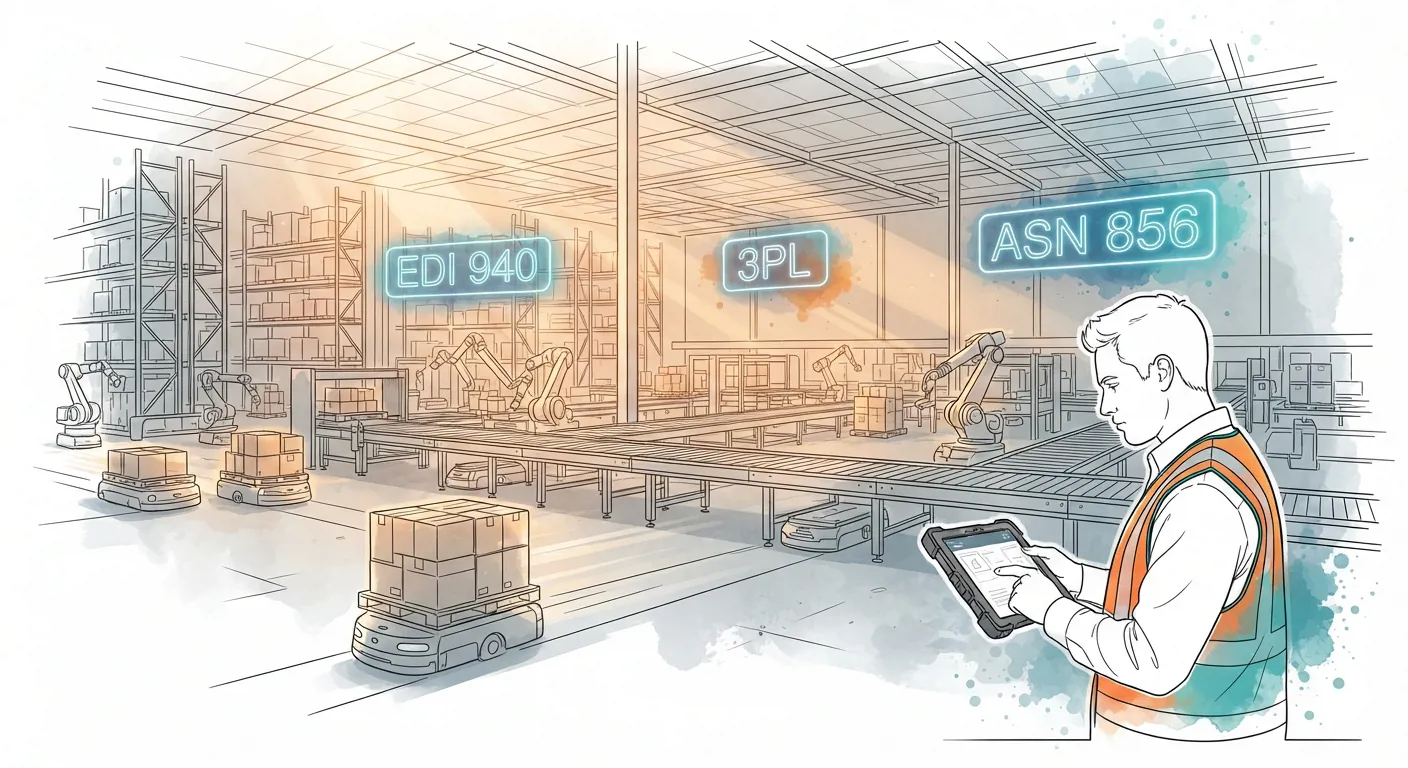
Third-party logistics providers operate in a high-stakes environment. Margins are razor-thin, turnaround expectations are measured in hours, and a single miscommunication can trigger a cascade of chargebacks from unforgiving retail partners. If you are managing a 3PL operation, you already know that manual processes are a ticking time bomb. The enhancement of your operations relies entirely on how fast and accurately data moves between you, your clients, and their customers.
This is where 3PL EDI transforms from a technical requirement into a strategic advantage. By replacing phone calls, emails, and manual data entry with standardized electronic document exchange, you fundamentally alter the speed and reliability of your logistics management. Let's break down how deep integration drives operational efficiency and how you can leverage it to scale your business without scaling your headaches.
The Core Challenge: Manual Processes vs. Automated Workflows
Consider the traditional lifecycle of a shipment in a non-integrated 3PL facility. A client sends a spreadsheet via email. A warehouse clerk manually enters the order into the WMS. The pickers pack the order, and a clerk manually types the tracking number back into an email to send to the client. Every single touchpoint is an opportunity for human error.
Automated EDI integration collapses this timeline. When a client's system generates an order, it automatically translates into an EDI document and lands directly in your WMS. When the truck pulls out of your dock, the system automatically fires off an Advance Ship Notice (ASN) to the client and the end retailer. The enhancement of this workflow is not incremental; it is exponential.
Visualizing the 3PL EDI Data Flow
Below is a modern illustration of how automated data flows through a typical 3PL EDI integration, eliminating manual touchpoints from order receipt to final delivery confirmation.
Key EDI Transaction Sets Driving 3PL Efficiency
To truly appreciate the enhancement EDI brings to logistics management, we need to look at the specific documents being exchanged. A 3PL relies on a highly specific subset of EDI transaction sets to manage warehouse operations.
- EDI 940 (Warehouse Shipping Order): Sent from the supplier to the 3PL, this document instructs the warehouse to fulfill an order. It contains item numbers, quantities, and ship-to addresses.
- EDI 945 (Warehouse Shipping Advice): Sent from the 3PL back to the supplier, confirming that the order has been shipped. It includes carrier details and tracking numbers.
- EDI 856 (Advance Ship Notice): The most critical document for retail compliance. It tells the receiver exactly what is in the shipment, how it is packed, and when it will arrive.
- EDI 810 (Invoice): Sent from the 3PL to the client, detailing the storage and handling fees accrued for the month.
- EDI 943 (Warehouse Stock Receipt): Sent from the 3PL to the supplier, confirming that inbound inventory has been successfully received and put away.
When these documents flow automatically, your warehouse staff spends zero time keying in data. They spend their time picking, packing, and shipping.
Quantifying the Impact: Manual vs. Integrated 3PL Operations
The theoretical benefits of 3PL EDI are clear, but supply chain leaders need to see the operational impact. The table below highlights the stark contrast between manual processes and a fully integrated EDI environment.
Seamless ERP and WMS Integration
The true power of 3PL EDI is unlocked only when it is deeply integrated into your core business systems. An EDI solution sitting in isolation is just another silo. The goal is to have data flow directly from your clients' systems into your Warehouse Management System (WMS) without human intervention. This requires robust API connectors and translation maps tailored to your specific software stack.
At Cogential IT, we specialize in building these exact bridges. Whether you are running a modern cloud WMS or a legacy ERP, our pre-built connectors ensure frictionless data movement. For instance, if you operate on 3PL Central, our integration ensures that EDI 940 orders drop directly into your picking queue instantly. For providers leveraging ShipBob infrastructure, we automate the outbound ASNs and tracking updates. Larger enterprises utilizing NetSuite WMS or SAP EWM benefit from our complex mapping capabilities, ensuring that high-volume retail orders are processed with zero latency.
Ensuring Trading Partner Compliance
For a 3PL, compliance is non-negotiable. Major retailers enforce strict routing guides that dictate exactly how labels must be formatted and how ASNs must be transmitted. Failing to meet these requirements results in chargebacks that can wipe out a month's profit.
Automated EDI ensures you meet these standards every single time. When you generate an EDI 856 ASN, the system automatically formats the hierarchical data (carton, pack, item) to the exact specifications of the receiver. Furthermore, automated barcode shipping label generation ensures that GS1-128 and SSCC labels are perfectly printed and scannable, preventing delays at the retailer's distribution center.
"Retailers like Walmart and Amazon don't care if a 3PL is small or large; they only care if the data is perfect. EDI automation is the great equalizer that allows smaller 3PLs to compete for massive contracts."
Cloud EDI vs. On-Premise for 3PLs
When considering an enhancement to your logistics infrastructure, the deployment model matters. Historically, 3PLs bought on-premise translator software, which required heavy IT investment. Today, the paradigm has shifted toward cloud-based EDI.
The Cloud Integration Architecture
Cloud EDI acts as a centralized hub. Instead of managing point-to-point connections with every client and retailer, your WMS connects to one cloud endpoint. The cloud provider handles the translation, mapping, and communication protocols (like AS2 or VAN).
Overcoming Implementation Hurdles
Implementing 3PL EDI is not without its challenges. The most common hurdle is the reluctance of internal teams to change established workflows. There is also the technical challenge of mapping data fields from a client's custom ERP format into a standardized EDI format.
To overcome this, efficiency must be the rallying cry. When warehouse managers see that automated EDI eliminates the end-of-day data entry rush, adoption follows naturally. Technically, partnering with an experienced EDI provider eliminates the mapping headaches. A provider brings a library of pre-tested maps for common retail partners and standard WMS platforms, drastically reducing time-to-value.
Conclusion
The role of a 3PL is to provide seamless, invisible fulfillment. You cannot achieve that invisibility if your data is stuck in email inboxes and spreadsheets. 3PL EDI is the foundational technology that enables true logistics management enhancement. By automating the flow of orders, ASNs, and invoices, you drive unparalleled operational efficiency and position your business as a reliable, scalable partner for major retailers and brands.
At Cogential IT, we understand the unique pressures of the 3PL industry. Our tailored warehouse and 3PL EDI solutions are designed to integrate flawlessly with your existing stack, ensuring rapid onboarding and error-free compliance. To learn more about our expertise and approach, visit our about us page. If you are ready to stop losing time to manual data entry and start scaling your fulfillment operations, reach out to our team through our contact us portal.
Transform Your 3PL Operations Today
Frequently Asked Questions
Discussion & Questions (0)
Get the Industry EDI Compliance Checklist
Use this checklist to prepare your Industry EDI workflow before onboarding.
Leave a Comment